For decades, conversations about women in business have focused on equality: equal opportunities, better representation, equal pay, and more women in leadership.
These conversations remain important. But I believe the next chapter needs to be bigger.
We need to move beyond asking how women can get a seat at the table. We need to ask who owns the table, who controls the capital, who makes the decisions, and who gets to shape the future of business.
The future of women in business isn't simply about having more women employed or promoted. It's about having more women building companies, owning assets, investing in businesses, leading industries, and influencing economic decisions.
And I believe Asia will be an increasingly important part of this story.
1. Asia has an opportunity to shape its own future
The United States and Europe have spent decades developing ecosystems around women's economic participation, including professional networks, leadership programs, investment communities, and business associations.
But significant gaps remain, particularly in access to venture capital, senior leadership, and investment decision-making.
Asia presents a different opportunity.
It is a diverse region with established financial centers such as Singapore, rapidly growing economies such as Vietnam and Indonesia, and major markets such as Thailand, Japan, and South Korea.
Women are already contributing to Asian economies as entrepreneurs, executives, professionals, and business owners. Yet access to capital, networks, ownership, and senior decision-making remains uneven.
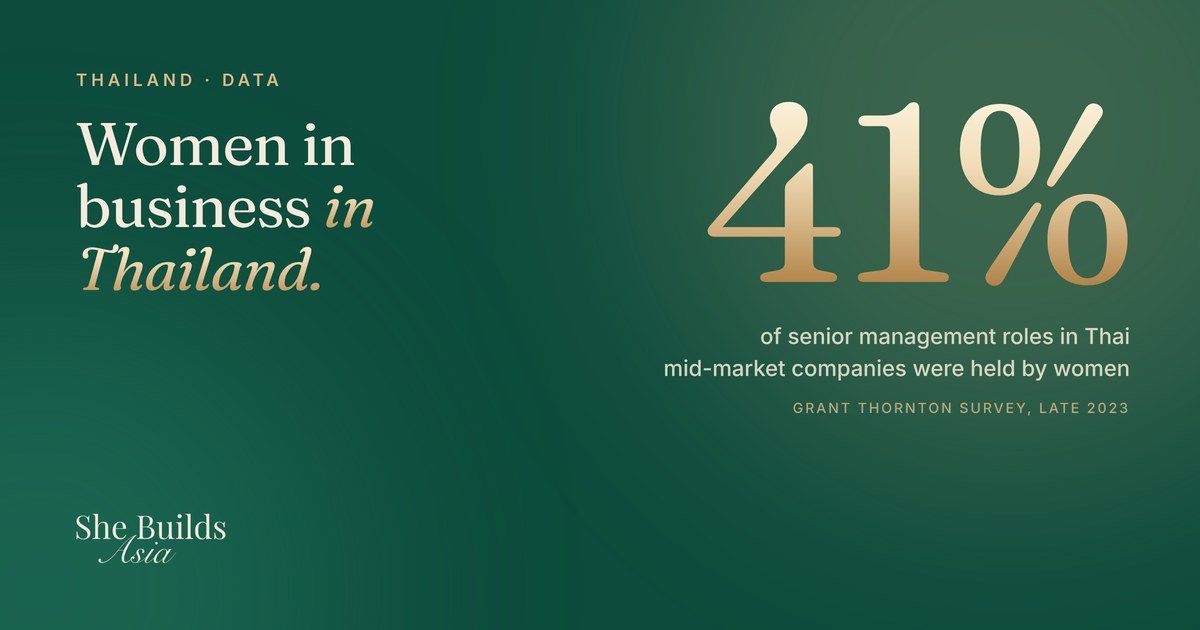
A 2025 review examining 1,600 companies across 16 Asian stock exchanges found that women held an average of just 18% of board seats and 7% of CEO positions. Thailand recorded the highest proportion of women CEOs among the markets studied, at 14%.
Source: [Gender Equality in Corporate Leadership: Asia 2025](https://www.weps.org/resource/gender-equality-corporate-leadership-asia-2025)
The opportunity is not to copy the Western model. It is to build an ecosystem that reflects Asia's own economic realities, cultural diversity, and entrepreneurial ambitions.
2. The next battle is ownership and capital
One of the biggest challenges is access to funding.
Starting a business and building a scalable company are two very different things. Growth requires capital, strategic networks, experienced advisors, and access to markets.
Research published by the International Finance Corporation in 2025 found that only 13% of private equity and venture capital funding in its emerging-market sample went to female-led companies.
Women were also underrepresented among senior investment partners.
Source: [IFC: Expanding Opportunities for Women through Private Equity and Venture Capital](https://www.ifc.org/en/insights-reports/2025/expanding-opportunities-for-women-via-private-equity-venture-capital)
This matters because ownership creates influence.
When women own companies, they build assets, create jobs, and generate wealth. When women become investors, they influence which ideas receive funding. When women hold decision-making positions, they shape the direction of industries.
The next generation of women's economic leadership needs more founders, but also more investors, shareholders, board members, and capital allocators.
3. Technology could change the rules of the game
AI, automation, and digital platforms are changing the cost and complexity of starting and running a business.
A founder can now access tools that previously required a much larger team and budget. Small businesses can reach international customers, and professionals can build independent businesses without necessarily leaving their careers.
This could create new opportunities for women, particularly those facing geographical, financial, or traditional workplace barriers.
But technology alone does not create equality. Access to skills, funding, and business networks still matters.
My prediction is that the next generation of successful women entrepreneurs will include more women building AI-enabled businesses, launching global brands, becoming independent consultants, investing in startups, and creating companies across borders.
The opportunity is significant, but women need the resources and connections to take advantage of it.
4. What could the next decade look like?
Looking toward 2030 and beyond, I see five potential shifts:
- From employees to owners: More women building companies, owning assets, and creating independent wealth.
- From fundraising to investing: More women becoming angel investors, venture capital partners, and decision-makers.
- From local businesses to global companies: Technology and cross-border networks making international expansion more accessible.
- From representation to influence: Measuring progress through ownership, economic power, and actual decision-making authority.
- From individual success to collective growth: Successful women funding, mentoring, introducing, and supporting the next generation.
These changes are not guaranteed. They require investment, policy support, institutional commitment, and stronger business ecosystems.
But they represent a future worth building toward.
5. Why do we need a different kind of platform?
There is no shortage of organizations supporting women in business.
We already have women's networking communities, professional associations, leadership programs, accelerators, mentorship networks, investment groups, and annual conferences.
They all play important roles. Some create visibility, others provide education, mentorship, or access to investors.
But there is an opportunity to bring these worlds closer together.
She Builds Asia aims to connect the people and opportunities that shape women's economic future.
Rather than focusing exclusively on networking, leadership development, or entrepreneurship, the ambition is to build a cross-industry platform connecting founders, investors, executives, professionals, organizations, and allies.
There are four ideas behind this approach:
- From inspiration to economic opportunity: Creating connections that can lead to clients, partnerships, investment, and business growth.
- From individual networks to regional ecosystems: Connecting people across industries and Asian markets.
- From women's advancement to economic power: Putting ownership, investment, entrepreneurship, and decision-making at the center.
- From a one-day event to a long-term platform: Using the annual conference as a starting point for relationships, partnerships, knowledge exchange, and future initiatives.
The ambition is not to replace existing communities and organizations. It is to connect and collaborate with them.
Because the future of women in business cannot be built by one organization alone. It requires an ecosystem.
6. A future built together, not separately
The future of women in business is not a conversation that should happen only among women.
Men have an important role to play as investors, business partners, executives, mentors, collaborators, and allies.
For men, engaging with women-led businesses and leadership communities is also an opportunity to discover new perspectives, meet talented founders, build strategic partnerships, and access business opportunities they might not otherwise encounter.
For women, connecting with male investors, executives, and business leaders can open doors to collaboration, capital, and new markets.
The goal isn't to create separate networks or exclusive rooms. It's to create more opportunities for people to work together, exchange ideas, and recognize talent regardless of gender.
That's why She Builds Asia is built around women but welcomes everyone.
Because a stronger ecosystem for women creates opportunities for businesses, industries, and the wider economy.
The future isn't about women building without men. It's about making sure women have an equal opportunity to build alongside them.
The future is not something we wait for. It's something we build.
I believe the next decade will create significant opportunities for women in business.
But progress will not happen simply because more women enter the workforce or start companies.
It will happen when more women have the capital to scale their businesses, the resources to invest in others, the influence to make decisions, and the networks to access opportunities beyond their immediate markets.
Asia has the talent, ambition, and entrepreneurial energy to play a much bigger role in this future.
What it needs is a stronger ecosystem to support that potential.
And perhaps the most important question is no longer whether women will be part of the future of business.
It's whether we are ready to give women the ownership, capital, influence, and opportunities to build it.