Ask most people where women are most likely to lead a business, and Thailand is rarely the first answer.
It should be.
For years, Thailand has quietly ranked among the global leaders for women in senior management. Walk into many Thai boardrooms, finance teams and family businesses, and you will find women making the decisions.
But leadership inside companies is only one part of the story. The bigger question for the next decade is whether that strength translates into ownership, capital and companies that scale beyond Thailand.
Here's what the data says, and what I believe comes next.
1. Thailand is a global leader in women's corporate leadership
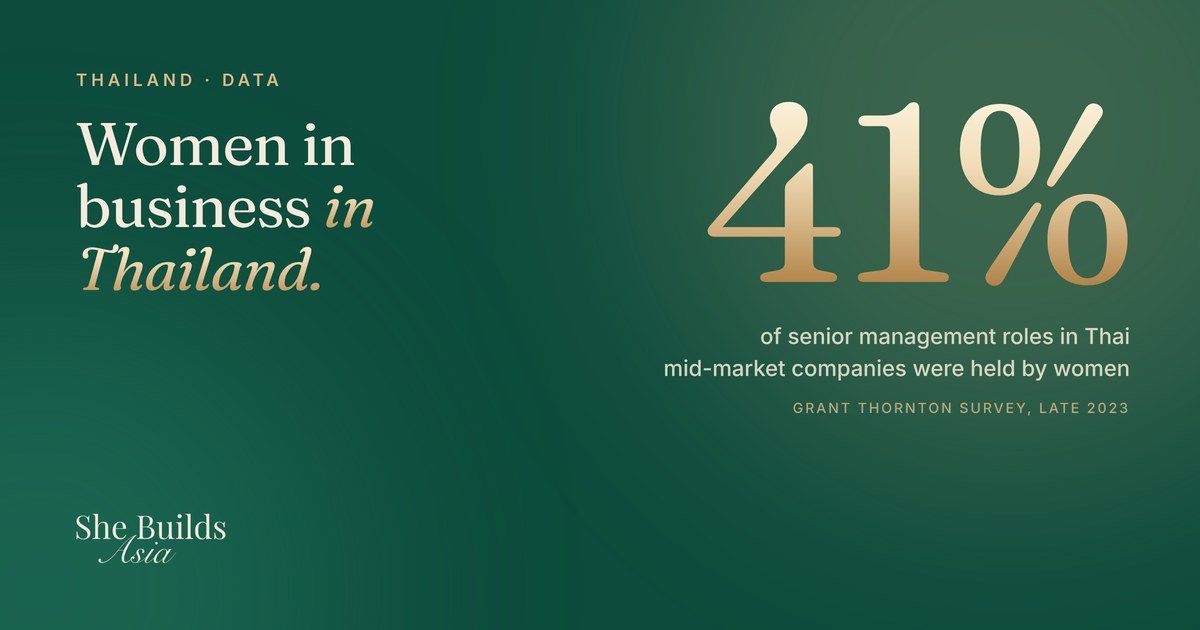
In Grant Thornton's survey of nearly 5,000 mid-market companies, conducted at the end of 2023, women held 41% of senior management roles in Thailand. That placed Thailand third in the world, and the country also led the surveyed nations for the share of women CEOs and managing directors.
Source: [Pattaya Mail: Thailand leads surveyed nations with highest percentage of female CEOs and MDs (Grant Thornton)](https://www.pattayamail.com/thailandnews/thailand-leads-surveyed-nations-with-highest-percentage-of-female-ceos-and-mds-grant-thornton-455459)
The pattern holds in listed companies too. A 2025 review of 1,600 companies across 16 Asian stock exchanges found that Thailand had the highest proportion of women CEOs among the markets studied, at 14%, compared with an average of 7%.
Source: [Gender Equality in Corporate Leadership: Asia 2025](https://www.weps.org/resource/gender-equality-corporate-leadership-asia-2025)
Finance is a particular strength. McKinsey, citing Grant Thornton data, noted that 43% of chief financial officers in Thailand were women, a higher share than anywhere else in the world at the time.
Source: [McKinsey: Shattering the glass ceiling in Thailand will take an all-of-society approach](https://www.mckinsey.com/featured-insights/future-of-asia/countries-and-regions/southeast-asia/southeast-asia-perspectives/shattering-the-glass-ceiling-in-thailand-will-take-an-all-of-society-approach)
This matters. It means Thailand already has something many countries are still trying to build: a deep bench of experienced women who understand money, operations and decision-making.
2. Leading a company is not the same as owning one
Here is where the picture changes.
Senior roles in established companies are a strong foundation. But the next level of economic power comes from ownership: founding companies, holding equity, investing and controlling capital.
Across emerging markets, that gap is still wide. IFC research published in 2025 found that only 13% of private equity and venture capital funding in its sample went to female-led companies.
Source: [IFC: Expanding Opportunities for Women through Private Equity and Venture Capital](https://www.ifc.org/en/insights-reports/2025/expanding-opportunities-for-women-via-private-equity-venture-capital)
In my experience, many talented Thai women build successful careers and profitable small businesses. Far fewer raise outside capital, expand regionally or become investors themselves.
The talent is there. The bridge from leadership to ownership is not yet strong enough.
3. The three barriers I see most often
From years of building communities and businesses in Bangkok, three barriers come up again and again.
Networks that stay local. Many women have strong networks within their industry or company, but fewer connections to investors, international partners and founders in other markets. Growth often depends on exactly those connections.
Capital that feels out of reach. Fundraising is still shaped by who knows whom. Without warm introductions, many women never get in front of the right investors, or decide not to try.
Visibility. Women are often doing the work without telling the story. In a market where opportunities travel through relationships and reputation, being invisible has a real cost.
None of these are about ability. They are about access.
4. What comes next for women in Thai business
I see four shifts that could define the next decade.
- From executives to founders: Experienced women leaving corporate roles to build companies, bringing deep industry knowledge with them.
- From founders to investors: Successful women business owners writing their first angel cheques and backing the next generation.
- From local to regional: Thai women-led businesses using digital tools and cross-border networks to reach Southeast Asia and beyond.
- From individual success to shared ecosystems: Communities, corporates, investors and venues working together instead of separately.
Thailand has the leadership talent to make all four happen. What it needs now are more bridges between them.
5. Why this needs to be built together
No single organization can close these gaps.
Corporates can develop women leaders and partner with women-led suppliers. Investors can widen their networks. Communities can make introductions. Venues and innovation hubs can bring these groups into the same room.
That is the idea behind She Builds Asia: connecting founders, executives, investors and professionals across industries, so that Thailand's leadership strength becomes ownership, capital and growth.
Thailand has already shown the world that women can lead. The next chapter is about making sure they can build, own and invest too.
The question is no longer whether Thai women can lead. It's whether we are ready to help them own what they build.